
Titleist Performance Institute
Your body decides your swing
That is the finding TPI is built on. There is no one correct way to swing a golf club — but there is one most efficient way for you to swing it, and what sets it is what your body can physically do.
Neil Thompson is TPI Level III certified, the top of the certification, and has been teaching since 1993.

Why a lesson might start away from the ball
Most golf faults get treated as habits. You come over the top, so you are told to stop coming over the top. You slide instead of rotating, so you are told to rotate. If the fault is a habit, that works.
TPI's contribution was to show how often it is not a habit. Screen enough players and the pattern repeats: a golfer who cannot separate their hips from their shoulders standing still is not going to do it at speed either. The swing is not the problem. It is the compensation.
That is what a screen is for. A short physical assessment — how you rotate, how you hinge, how you balance — done before anyone talks about takeaway. It separates the faults you can fix this afternoon from the ones your body is currently making unavoidable, so a lesson is not spent asking you for a move you cannot yet make.
It is not a fitness test and you do not need to be injured, an athlete, or young. It is a measurement of how you move.
What "TPI certified" actually means
The phrase gets used loosely. It is a ladder, and the rungs are a long way apart.
Level 1
The body-swing connection and the screen itself. Where everyone starts, and where most people who describe themselves as TPI certified have stopped.
Level 2
Splits into five separate tracks — Golf, Medical, Fitness, Junior and Power. Each is its own qualification, taken one at a time.
Level 3
The end of a track. Neil holds Level III. It is not a weekend course, and it is not reached by taking one.
The screen is the same instrument at every level. What changes is how much of the picture you can read from it, and what you are qualified to do next.
Neil Thompson, PGA
The rest of the wall
Certifications
- TPI Level III — Titleist Performance Institute
- Class A, PGA of America — since April 2000
- Class A, PGA of Great Britain & Ireland — since January 1999
- K-Vest — 3D motion capture
- Trackman — ball flight analysis
- Club fitting — qualified and certified
Section awards
- 2022 — Alabama Chapter Teacher of the Year, Alabama/NW Florida Section
- 2017 — Youth Player Development Award, Alabama/NW Florida Section
- 2014 — Player Development Award, Dixie Section
- 2011 — PGA Teacher of the Year, Dixie Section
- 2009 — Alabama Chapter Teacher of the Year, DSPGA
Plus multiple honorable mentions for the U.S. Kids Top 50 National Junior Teacher of the Year.
In the bay
The floor is an instrument
A screen tells you how your body moves standing still. The harder question is whether it does the same thing at 90 miles an hour, and that is where most indoor golf stops being able to help.
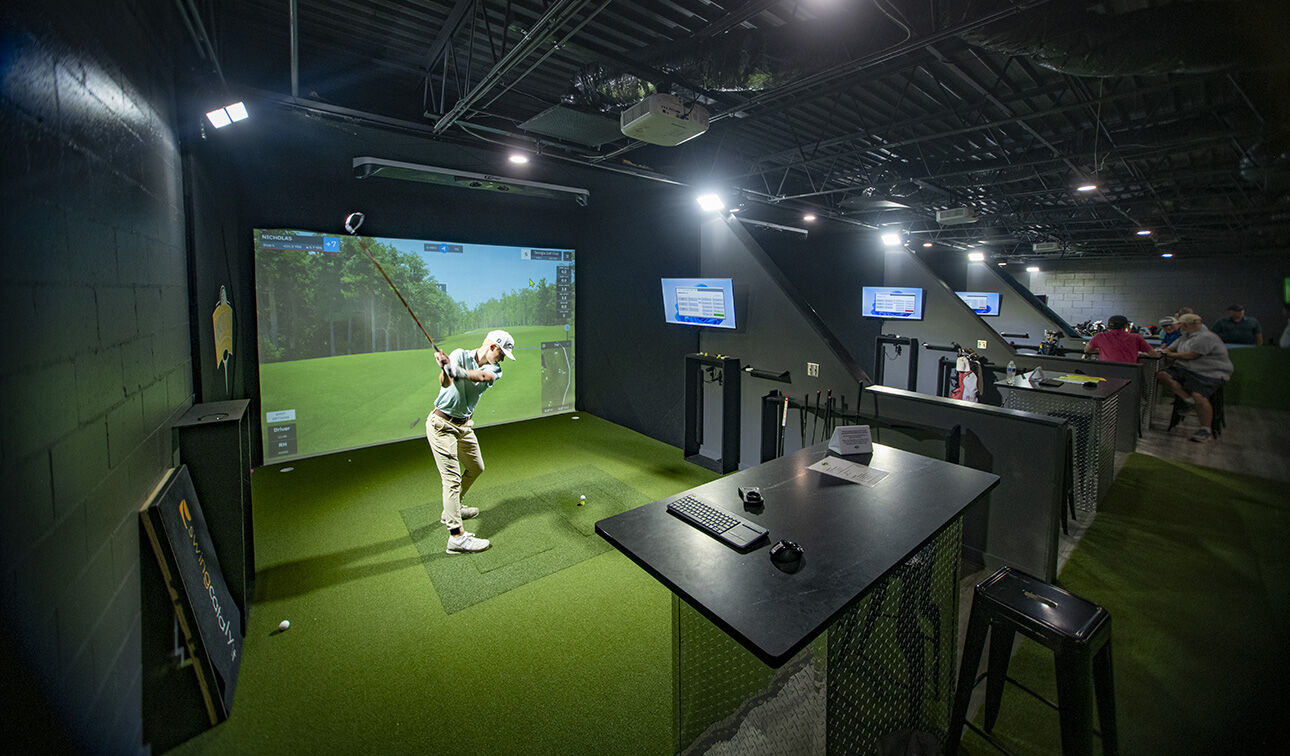
Every bay here has a Swing Catalyst balance plate under it, measuring where your weight actually is through the swing rather than where it looks like it is. Put that next to a physical screen and the two answer each other: the limitation the screen found either shows up in the ground data or it does not.
High-speed video, launch data from the GC Falcon overhead, and a professional who can read all three at once.
Common questions
Do I have to be a good player for this to be worth it?
No — it is arguably worth more if you are not. A beginner told to make a move their body cannot currently make will conclude they are bad at golf. They are not.
Is this physiotherapy?
No. Neil is a golf professional, not a medical practitioner. A screen finds what your body is doing to your swing; if something needs actual treatment, that is a referral, not a lesson.
Do I need to be a member?
No. Lessons are open to anyone. Membership changes the price of bay time, not who can book a lesson.
How do I start?
The free swing evaluation costs nothing and carries no obligation. If you would rather go straight in, book a lesson with Neil or call (205) 593-4543.
Find out what your body is doing to your swing
Start with the free evaluation. It costs nothing and takes half an hour.